
In the contemporary landscape of digital innovation,
Digital Product Passports Are Now Mandatory for EU Textile Sales.
Here’s What That Actually Means.
As of January 2026, the EU’s Ecodesign for Sustainable Products Regulation stopped being a future concern and became operational reality. If you sell textiles in Europe, you need Digital Product Passports. Not eventually, now.
What Changed
For years, fashion brands relied on vague “eco-friendly” labels and periodic supplier declarations. That approach just died. Digital Product Passports require verifiable, machine-readable data at the product level. Not corporate sustainability reports. Not supplier certifications. Actual data proving what your garment is made from, where it came from, and how it performs across its entire lifecycle.
Who This Hits
Every textile product placed on the EU market needs a DPP: apparel, footwear, home textiles, even technical fabrics. “Placed on the market” means sold, distributed, or made available in the EU—regardless of where it was manufactured. Non-EU brands shipping to European customers fall under the same requirements as EU manufacturers. No exceptions.
What You Actually Need
Material composition down to fiber percentages. Multi-tier supplier data, not just your Tier-1 factory, but the dyehouses and mills where real environmental impact happens. Sustainability metrics with numbers: carbon footprint, water use, recycled content, durability. Compliance proof on REACH and human rights due diligence. The EU wants lifecycle data that updates over time. Static PDFs don’t work.
Why Most Brands Aren’t Ready
Manual spreadsheets can’t scale. When the same fabric gets labeled differently across your systems, you can’t prove traceability.
Disconnected systems mean compliance can’t talk to design, who can’t talk to sourcing. Without integration, you’re generating DPPs manually, which regulators reject.
At its core, blockchain technology facilitates immutable and transparent record-keeping, ideal for tracing the journey of goods, data, or assets. However, when integrated with edge computing, which processes data near the source rather than in distant data centers, its potential magnifies exponentially.
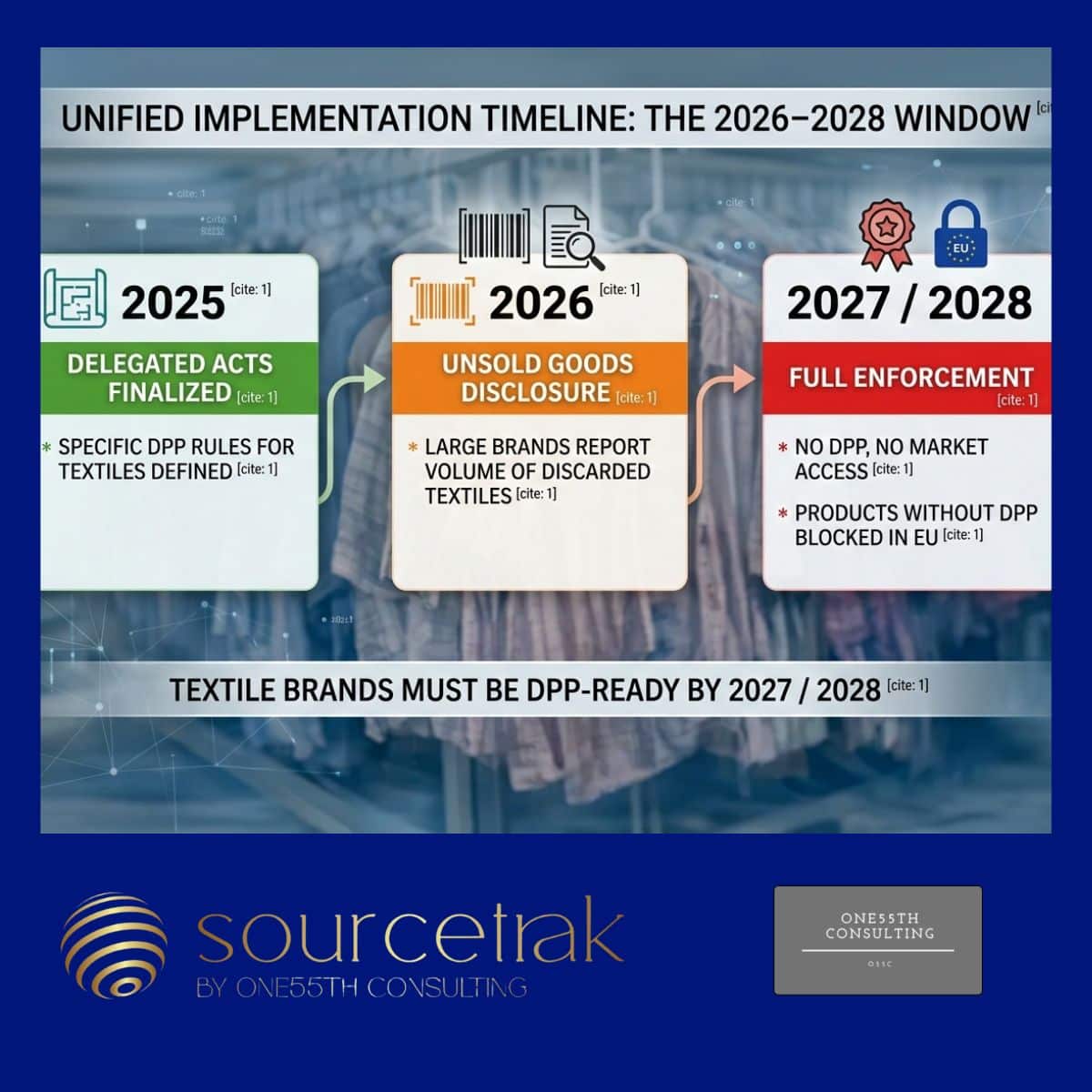
Where One55thSourceTrak Solves This
Our platform captures supplier data, materials, and lifecycle events in one system. Every product gets a machine-readable record that updates automatically.
When EU customs asks for DPP data, you’re generating audit-ready documentation instantly, not compiling spreadsheets.
DPPs aren’t just compliance checkboxes. They’re infrastructure for the next decade of textile regulation.
Ready to build DPP-compliant infrastructure before market access becomes an issue?
Let’s discuss One55thSourceTrak.