
2026: The Year Food Manufacturers Stop Winging It
Here’s the reality nobody wants to admit: most food manufacturers are still running on spreadsheets, manual logs, and crossed fingers. That approach is about to hit a wall.
January 2026 brings a wave of regulations that don’t just ask for better data, they demand it. And if you can’t produce accurate, auditable records instantly, you’re facing more than fines. You’re facing lost contracts.
What’s Actually Changing
UK advertising restrictions hit January 5th. “Less-healthy” foods face a 9pm TV watershed and online ad limits. You need accurate nutritional data for product classification, data that’s probably scattered across multiple systems.
Extended Producer Responsibility (EPR) starts January 2026. Report detailed packaging data, materials, weights, recyclability, or pay higher fees for non-compliance.
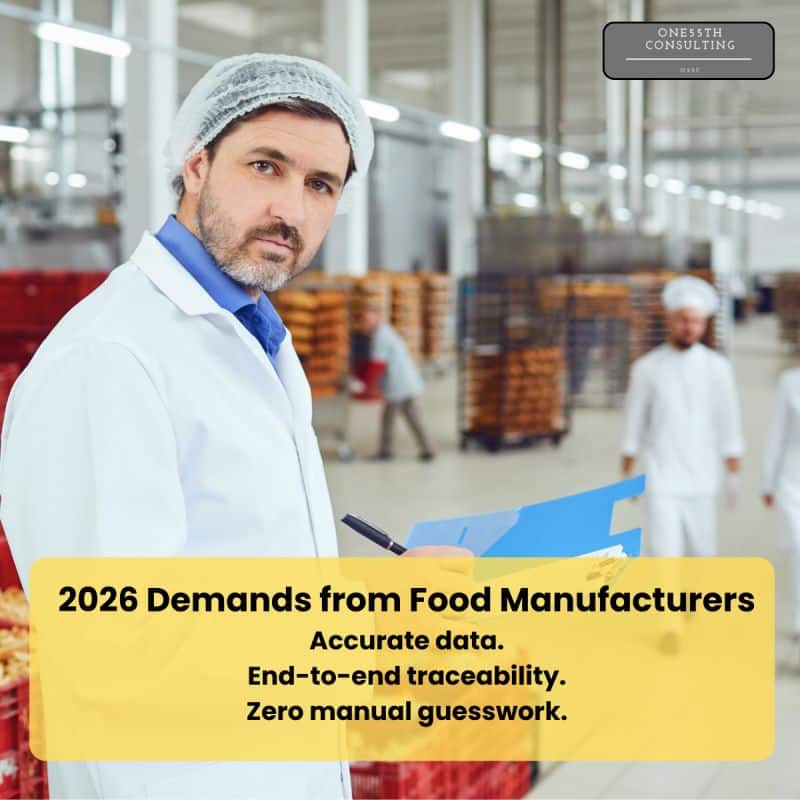
Traceability expectations are tightening. Retailers want you to trace ingredients from intake to dispatch in seconds. Every label verified, every batch tracked, zero manual entry.
Sustainability reporting is becoming mandatory. Food waste metrics, packaging errors, yield data, transparency isn’t optional anymore.
Why Manual Systems Are Done
The problem isn’t understanding the rules. It’s having the data when someone asks for it. Disconnected spreadsheets, paper logs, and reactive processes can’t keep up. One audit request, one retailer questionnaire, one recall scenario, and you’re scrambling.
Meanwhile, your competitors with automated systems are pulling reports in seconds.
At its core, blockchain technology facilitates immutable and transparent record-keeping, ideal for tracing the journey of goods, data, or assets. However, when integrated with edge computing, which processes data near the source rather than in distant data centers, its potential magnifies exponentially.
Where One55thSourceTrak Solves This
Our blockchain platform wasn’t built for 2026, it was built for every regulation that comes after it too. Automatic traceability from raw material to finished product. Real-time waste tracking. Verified labeling. Packaging data captured at every step.
When auditors ask for proof, you’re not digging through folders. When retailers demand sustainability metrics, you’re not compiling spreadsheets. Everything’s already tracked, verified, and audit-ready.
EPR, traceability, waste reporting, nutritional accuracy, they all become automatic.
The Bottom Line
2026 is when “we’ve always done it this way” stops being acceptable. The businesses that survive are the ones who stopped treating compliance as paperwork and started treating it as infrastructure.
Ready to automate compliance before the deadline hits? Discover One55thSourceTrak.